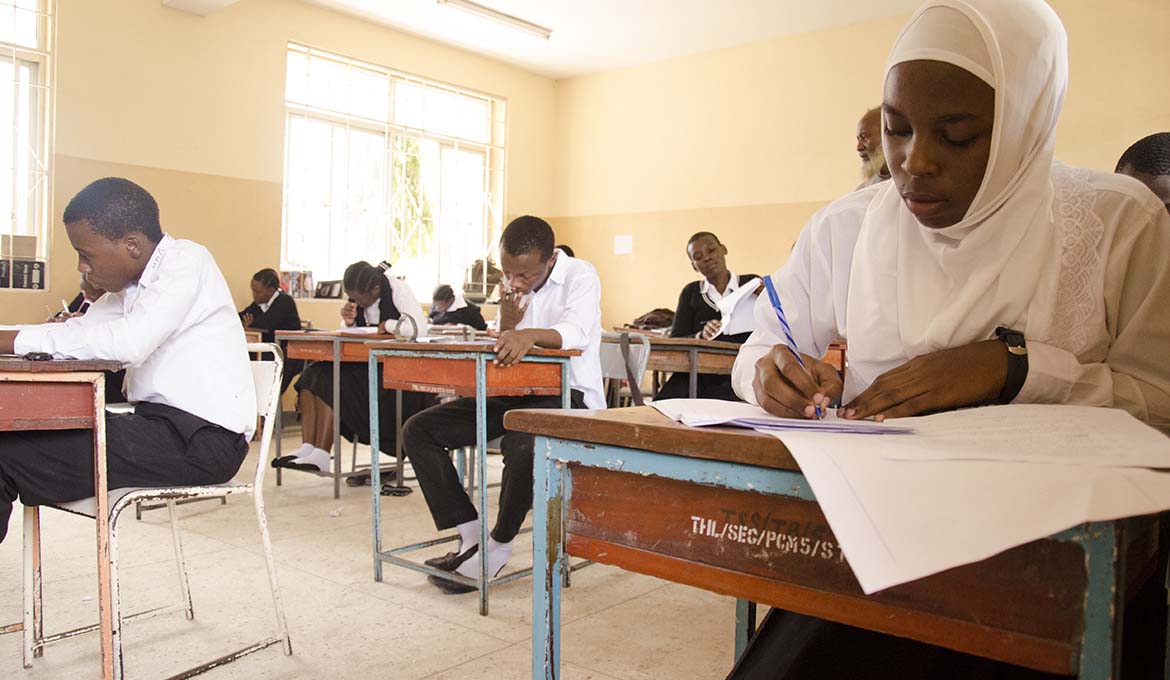
FORM FOUR NECTA EXAMINATIONS 2025 WITH MARKING SCHEMES

Form Four NECTA 2025 · past papers + marking schemes

📘 FORM FOUR NECTA 2025

with MARKING SCHEMES ✅
🎓 CSEE past papers · all subjects · free PDF

Welcome to the ultimate resource for Form Four NECTA Examination 2025 preparation!

🔍 NECTA Form Four Past Papers + Marking Schemes — Physics, Basic Math, English, BAM, Academic Comm, Chemistry, Biology, Geography, History, Kiswahili & more.

✅ What's inside:

📌 Past papers 2025 (answers) 📌 Marking schemes 📌 Mock exams (Dar, Arusha, Mwanza...) 📌 Joint (KATSEC, MTAA) 📌 Revision + solved 📌 Download PDF free 📌 2024 2023 2022 2021 2020

📘 Subjects:

📐 Basic Math ⚡ Physics 🧪 Chemistry 🌍 Geography 📜 History 📖 Kiswahili 💬 English 💼 BAM 🗣️ Academic Comm 🧬 Biology 💻 Computer Studies 📊 Commerce
📥 How to download: Tap the green button for paper, orange/brown for marking scheme.
⬇️ GOOGLE DRIVE paper + MS
BASIC MATHEMATICS
BIOLOGY 01
CHEMISTRY 01
CHEMISTRY 2A
PHYSICS 01
ENGLISH LANGUAGE
ENGLISH LITERATURE
INFO. & COMP. STUDIES
ICS ACTUAL PRACTICAL

🔁 We appriciate your contribution to our blog share with us your views on comment below

🔑 Keywords for description / tags

Form Four NECTA 2025NECTA Past PapersCSEE Past Paperswith Marking SchemesNECTA Marking SchemesMock Exams 2025Joint Exams Form FourDownload PDFBasic Mathematics Past PapersPhysics Past PapersEnglish Past PapersBAM Past PapersAcademic CommunicationNECTA 202420232022Kidato cha NneMitihani ya NECTAMaswali na MajibuCSEE All SubjectsTanzania Form Four

⚡ Don't give up on bringing up this generation Better Tanzania is in your hands.

The Moon's Gravity: How Tides Work | Earth Science

The Moon's Gravity: How Tides Work | Earth Science

🌊 The Moon’s Silent Pull: The Full Story of Earth’s Tides

How a celestial dance 384,400 km away shapes our shorelines twice a day

The gravitational pull of the Moon affects Earth’s oceans, causing the phenomenon known as tides. This simple statement describes one of the most elegant and complex interactions in the Earth–Moon system. But what really happens? Why do most coastlines experience two high tides and two low tides every day? And why does the Sun, despite being enormously larger, play only a supporting role? Let’s expand this cosmic ballet.

The Moon’s gravity does not pull uniformly on Earth. Because gravitational force weakens with distance, the side of Earth facing the Moon feels a stronger pull than the planet’s centre, and the far side feels a weaker pull. This difference—called the tidal force—stretches the entire planet, but because water flows easily, the effect is most visible in the oceans. The water on the near side is pulled toward the Moon, creating a bulge. Meanwhile, on the far side, a second bulge forms because the solid Earth is pulled away from the water, leaving relatively more water behind. These two bulges are the high tides. As Earth rotates on its axis, any given point on the coast passes through both bulges each day, explaining the familiar two high tides.

But the Moon is not stationary—it orbits Earth every 27.3 days. This movement means that a fixed point on Earth needs, on average, an extra 50 minutes to realign with the Moon, shifting tide times daily. This delay creates the tidal cycle we observe. And the Sun? Though 27 million times more massive than the Moon, it is 390 times farther away, making its tidal force only about 46% that of the Moon. When the Sun, Moon, and Earth align (new moon or full moon), their forces combine to produce spring tides—higher high tides and lower low tides. When they are at right angles (quarter moons), the Sun partially cancels the Moon’s pull, creating milder neap tides.

The story grows richer with coastal geography. In narrow bays or river mouths, the tidal bulge can funnel into a towering tidal bore. In places like the Bay of Fundy (Canada), the shape of the basin resonates with the tidal period, producing the world’s largest tidal range—over 16 metres. Conversely, some enclosed seas like the Mediterranean experience barely perceptible tides because their connection to the open ocean is narrow and the basin’s natural period does not match the tidal forces.

Tides are not just ocean phenomena; they also create Earth tides (the solid ground rises and falls by about 30 cm) and even atmospheric tides. Moreover, tidal friction is slowly slowing Earth’s rotation and pushing the Moon farther away—about 3.8 cm per year. This means that millions of years ago, days were shorter and the Moon loomed larger in the sky, producing far more extreme tides.

🌙 Beyond the textbook: Tides also influence marine ecosystems, coastal navigation, and even the timing of animal behaviour (like grunion spawning or horseshoe crab mating). Ancient fishermen and sailors understood tidal patterns long before Newton explained gravity. Today, we use sophisticated models to predict tides decades in advance, but the primal engine remains the same: the patient, persistent pull of our nearest cosmic neighbour.

So next time you stand at the shoreline and watch the water rise or retreat, remember: you are witnessing the direct touch of the Moon—a gravitational conversation between Earth and its partner, spoken in the language of moving oceans. The tides are proof that even 384,400 kilometres away, the Moon never stops reaching for us.

FORM FIVE JANUARY MONTHLY TEST

Form Five: Monthly Tests & Subject Resources

📘 Form Five · Monthly Mastery

Assess · Reflect · Excel — the role of monthly tests in the final leap

Monthly tests in Form Five are far more than routine assessments—they are the scaffolding upon high-stakes success is built. At this advanced stage, students face the culmination of secondary syllabus and the gateway to tertiary education. Monthly examinations serve as vital pulse-checks, revealing gaps in understanding before they become chasms. They dismantle the illusion of knowledge: a topic may feel familiar during reading, but a timed test exposes what is truly mastered versus merely recognised.

Cognitively, these regular assessments leverage the testing effect—the proven phenomenon where frequent retrieval practice strengthens neural pathways, making recall during final exams faster and more reliable. Each monthly test is a rehearsal for the real performance. It trains students to manage anxiety, allocate time per question, and decode complex exam phrasing under pressure. Without this rhythm, the leap to trial exams can feel overwhelming.

For subjects like Advanced Mathematics and Physics, monthly tests force continuous problem‑solving practice; concepts in calculus or electromagnetism are not absorbable in one sitting—they require repeated application. In English and Academic Communication, monthly assessments refine essay structure, academic tone, and critical thinking. They push students to synthesise ideas rather than regurgitate notes. Even for BAM (Business, Accounting and Management), monthly tests mirror real-world financial analysis under time constraints, building professional rigour.

Moreover, these tests provide actionable data—for teachers to adjust instruction, and for students to pivot their focus. A下滑 in one subject signals the need for strategic help before it’s too late. They also cultivate discipline: the habit of consistent revision replaces last‑minute cramming. Form Five is a marathon; monthly tests are the split times that keep the runner on pace. Ultimately, they transform passive learners into active architects of their own understanding, building both competence and confidence for the final national examinations.


📂 DRIVE ACCESS subject resources — Form Five

Click any subject to download the latest monthly test package (papers, marking schemes, or core notes) directly from Google Drive.

📖
ENGLISH
Language & Literature
⬇️ OPEN DRIVE
🗣️
ACADEMIC
COMMUNICATION
research & discourse
⬇️ OPEN DRIVE
📊
BAM
business · accounting · mgmt
⬇️ OPEN DRIVE
🧮
ADV. MATH
pure · applied · mechanics
⬇️ OPEN DRIVE
PHYSICS
electricity · mechanics · modern
⬇️ OPEN DRIVE

🔒 Instructor instructions:

Each button above contains a placeholder link. To connect your actual Google Drive files:

  • Thank you for being a member of Mitihani Popote Family.
  • Your contribution is highly appriciated.
  • If you have any inquiries please don't hesitate to comment below .
⚡ Monthly test packages updated regularly. · direct access · request re-upload · #FormFive

Hydro-Electric Power Production

Hydroelectric Power | Classroom Physics

From Gravity to Electricity: The Science of Hydropower ⚡

Have you ever looked at a massive dam or a rushing river and wondered how we capture that raw power to light up our cities? It’s one of the most elegant and fascinating examples of energy transformation in the modern world. In this deep dive, we are moving beyond the simple statement that "flowing water spins turbines." We are going to unpack the entire journey—from the potential energy stored in a raindrop to the kinetic energy that spins a massive rotor, and finally, to the alternating current that powers your home.

Welcome to Mitihani Popote, where we peel back the layers of classroom subjects to reveal the fascinating science hiding in plain sight. Today, we’re exploring hydroelectric power, a cornerstone of renewable energy and a perfect case study for understanding the Laws of Thermodynamics, electromagnetism, and mechanical engineering.

The Dam: A Battery Built by Nature and Physics

Our story begins not with movement, but with stillness. When a river is dammed, a reservoir is created. To the naked eye, this looks like a massive, static lake. But to a physicist, it’s a giant battery storing gravitational potential energy. Every single liter of water held behind that dam is waiting—primed by gravity to fall. The higher the water is stored (the "head"), and the more water there is (the "flow"), the more potential energy is available. This concept, Potential Energy, is a key topic in any Physics classroom. It’s energy that is stored, not currently in motion, but with the inherent ability to become kinetic. Imagine holding a ball at the top of a staircase; it’s the same principle, just on a monumental scale.

The Controlled Release: From Potential to Kinetic

When energy demand rises—say, in the evening when everyone comes home and turns on their lights—the dam operators open the intake gates. This is the moment of transformation. Gravity takes over, and the still water of the reservoir becomes a torrent of motion, rushing down massive tunnels called penstocks. This flow converts that stored Potential Energy into Kinetic Energy—the energy of motion. The water, once calm, now slams into the blades of the turbine with immense force. This is a perfect real-world example of the Law of Conservation of Energy, which states that energy cannot be created or destroyed, only transformed.

The Turbine: Harnessing the Flow

Let’s talk about the turbine itself. It might look like a giant propeller or a water wheel, but it’s a precision piece of engineering. As the high-velocity water strikes the turbine blades, it causes the entire assembly to spin at a high speed. We have now transformed the kinetic energy of moving water into Mechanical Energy—the energy of a rotating shaft. This is the same principle you see in a wind turbine or even an old-fashioned hand crank. The shaft of the turbine isn't just spinning for fun; it’s connected directly to the heart of the power plant: the generator.

The Generator: Spinning Magnets and the Birth of Electricity ⚡

This is where the real magic happens, and where we dive deep into Electromagnetism, a core concept in high school and university Physics. Inside the generator, the spinning turbine shaft is connected to a rotor wrapped in giant electromagnets. This rotor sits inside the stator, which is a drum lined with thousands of loops of copper wire. As the magnets spin past these coils of wire, they create a constantly changing magnetic field. This action *induces* a flow of electrons in the copper wires. This phenomenon is called electromagnetic induction, discovered by Michael Faraday in the 1830s. It’s a beautiful principle: you put in mechanical energy (spinning), and you get out electrical energy.

The electricity produced is then sent to a transformer at the power plant. Transformers (another fantastic application of electromagnetism) "step up" the voltage of the electricity so it can travel long distances across transmission lines without losing too much energy. By the time it reaches your neighborhood, other transformers "step down" the voltage to a safe level for your home, ready to power your devices, lights, and appliances.

Why This Matters in Your Classroom and Beyond

Understanding hydroelectric power isn't just about knowing where electricity comes from. It's a masterclass in interconnected scientific principles. In this single process, we’ve touched on Gravitational Potential Energy (Physics), Kinetic Energy (Physics), Mechanical Work (Physics & Engineering), Electromagnetic Induction (Physics), and Alternating Current (Physics & Electronics). It also opens the door to discussions about renewable vs. non-renewable resources, environmental impact, and sustainable engineering—topics relevant to Environmental Science and Geography.

On this channel, we’re dedicated to making these connections for you. We take the isolated topics from your textbooks and show you how they combine to build the modern world. If you found this deep dive into hydropower enlightening, you’ll love our upcoming series on Thermodynamics in Car Engines and the Chemistry of Lithium Batteries.

Don't just memorize facts—understand the universe. Hit that subscribe button and join our community of lifelong learners. New videos every week that make classroom subjects come alive.


Keywords: Hydroelectric Power, How Dams Work, Renewable Energy, Physics Explained, Electromagnetic Induction, GCSE Physics, A-Level Science, Potential and Kinetic Energy, Science Homework Help, Engineering Explained.

FORM SIX PRE NATIONAL EXAMINATION PHYSICS 1 - SERIES 18 (With Comprehensive Solution)

PRE NATIONAL EXAMINATION PHYSICS 1 - SERIES 18
UMOJA WA WAZAZI TANZANIA
WARI SECONDARY SCHOOL
PRE-NATIONAL EXAMINATION SERIES
PHYSICS 1 - SERIES 18
131/01
TIME: 2:30 HRS
JANUARY - MAY, 2023

Instructions

  1. This paper consists of sections A and B with a total of ten (10) questions.
  2. Answer ALL questions from section A and any two (2) questions from section B.
  3. Marks for each questions or part thereof are indicated.
  4. Mathematical tables and non-programmable calculators may be used.
  5. The following information may be useful:
    (a) Molar gas constant, \( R = 8.31 \, \text{J/molK} \) (b) Planks constant, \( h = 6.62 \times 10^{-34} \, \text{Js} \)
    (c) Resistivity of nichrome, \( ρ = 10 \times 10^7 \, \Omega m \) (d) Triple point of water = \( 273.16 \, \text{K} \)
    (e) Density of sea water, \( ζ = 1023 \, \text{kg/m}^3 \) (f) Resistivity of constantan, \( ρ = 4.9 \times 10^7 \, \Omega m \)
    (g) Radius of the earth, \( R_e = 6.4 \times 10^6 \, m \) (h) Boltzman constant, \( k = 1.38 \times 10^{23} \)
SECTION A (70 MARKS)

Answer ALL questions from this section

1.
(a) (i) Briefly explain what is the basic requirement for a physical relation to be correct? (01 mark)
(ii) In the physical relation below, P is power, X is distance and t is time. \[P = \frac{C - X^2}{Gt}\] What is the dimension of constant G in the relation above? (02 marks)
(b) (i) The glass block of mass \( (1.25 \pm 0.01) \) g has a length of \( (25.12 \pm 0.05) \) cm. Determine the maximum possible error in density, briefly explain which physical quantity is mostly measured accurately in the measurement of density? (05 marks)
(ii) A jet of water of cross sectional area A and velocity V strikes normally on a stationary flat plate. The mass per unit volume of water is Q, derive an expression for the force F exerted by the jet against the plate. (02 marks)
2.
(a) (i) Explain how you can throw a projectile so that it has zero speed at the top of the trajectory. (01 mark)
(ii) A ball is projected with a velocity of 20m/s. If the range of the ball on the horizontal plane is 35m. Find the two possible angles of projectile. (03 marks)
(b) (i) At what distance from the equilibrium position is the kinetic energy equal to the potential energy in simple harmonic motion? (03 marks)
(ii) A particle performs SHM of period 6 seconds and amplitude 4 cm about a centre O. Find the time it takes the particle to travel to a point P, a distance of 2 cm from centre O. (03 marks)
3.
(a) (i) Under what condition a linear momentum of a system is conserved? (02 marks)
(ii) The point A is vertically below the point B. A particle of mass 0.1kg is projected from A vertically upwards with speed 21m/s and passes through point B with speed 7m/s. Find the distance from A to B. (03 marks)
(b) (i) Why weight of a body becomes zero at the centre of earth? (02 marks)
(ii) At what height from the surface of earth will the value of g be reduced by 48% from the value at the surface? (03 marks)
4.
(a) (i) State work-energy theorem in rotation motion and use it to prove that \( \tau = I\alpha \), where \( \tau \) is torque, I is moment of inertia and \( \alpha \) is the angular acceleration. (02 marks)
(ii) A wheel of mass 4kg is pulled up a plane, inclined at 30° to the horizontal by a force of 45N applied to the axle and parallel to the plane. If the wheel has radius 0.50m and moment of inertia of 0.50kgm². Calculate the translational velocity acquired after travelling 12m up the plane, assuming the wheel is initially at rest. (03 marks)
(b) (i) Why are passengers of a car rounding a curve thrown outward? (01 mark)
(ii) A small mass of 0.15kg is suspended from a fixed point by a thread of fixed mass is given a push so that it moves along a circular path of radius 1.82m in a horizontal plane at a steady speed taking 18.0 seconds to make ten complete revolutions. Calculate the centripetal acceleration and the tension in the thread. (04 marks)
SECTION B (30 MARKS)

Answer any TWO (2) questions from this section

8.
(a) (i) Briefly explain the three regions of the transistor how are differently doped. (03 marks)
(ii) Under what condition a transistor acts as an oscillator? (02 marks)

END OF EXAMINATION

Page 6 of 6

PRE NATIONAL EXAMINATION PHYSICS 1 - SERIES 18
UMOJA WA WAZAZI TANZANIA
WARI SECONDARY SCHOOL
PRE-NATIONAL EXAMINATION SERIES
PHYSICS 1 - SERIES 18
131/01
TIME: 2:30 HRS
JANUARY - MAY, 2023

Instructions

  1. This paper consists of sections A and B with a total of ten (10) questions.
  2. Answer ALL questions from section A and any two (2) questions from section B.
  3. Marks for each questions or part thereof are indicated.
  4. Mathematical tables and non-programmable calculators may be used.
  5. The following information may be useful:
    (a) Molar gas constant, \( R = 8.31 \, \text{J/molK} \) (b) Planks constant, \( h = 6.62 \times 10^{-34} \, \text{Js} \)
    (c) Resistivity of nichrome, \( ρ = 10 \times 10^7 \, \Omega m \) (d) Triple point of water = \( 273.16 \, \text{K} \)
    (e) Density of sea water, \( ζ = 1023 \, \text{kg/m}^3 \) (f) Resistivity of constantan, \( ρ = 4.9 \times 10^7 \, \Omega m \)
    (g) Radius of the earth, \( R_e = 6.4 \times 10^6 \, m \) (h) Boltzman constant, \( k = 1.38 \times 10^{23} \)
SECTION A (70 MARKS)

Answer ALL questions from this section

1.
(a) (i) Briefly explain what is the basic requirement for a physical relation to be correct? (01 mark)

Solution 1(a)(i):

The basic requirement for a physical relation to be correct is dimensional homogeneity.
This means that both sides of the equation must have the same dimensions. Each term in the equation must have the same fundamental dimensions (mass, length, time, etc.) for the equation to be physically valid.
For example, in the equation \( F = ma \), the left side has dimensions [MLT⁻²] and the right side also has dimensions [M][LT⁻²] = [MLT⁻²].
The basic requirement is dimensional homogeneity - both sides of the equation must have the same dimensions.
(ii) In the physical relation below, P is power, X is distance and t is time. \[P = \frac{C - X^2}{Gt}\] What is the dimension of constant G in the relation above? (02 marks)

Solution 1(a)(ii):

Given: P is power, X is distance, t is time
Dimensions: [P] = [ML²T⁻³], [X] = [L], [t] = [T]
The equation is: \( P = \frac{C - X^2}{Gt} \)
For dimensional consistency, C must have the same dimensions as X², so [C] = [L²]
Rewriting: \( P \cdot G \cdot t = C - X^2 \)
Dimensions: [ML²T⁻³] · [G] · [T] = [L²]
Simplifying: [ML²T⁻²] · [G] = [L²]
Therefore: [G] = [L²] / [ML²T⁻²] = [M⁻¹T²]
The dimension of constant G is [M⁻¹T²]
(b) (i) The glass block of mass \( (1.25 \pm 0.01) \) g has a length of \( (25.12 \pm 0.05) \) cm. Determine the maximum possible error in density, briefly explain which physical quantity is mostly measured accurately in the measurement of density? (05 marks)

Solution 1(b)(i):

Given: Mass m = (1.25 ± 0.01) g, Length L = (25.12 ± 0.05) cm
Assuming the block is a cube, volume V = L³
Density ρ = m/V = m/L³
The relative error in density: Δρ/ρ = Δm/m + 3·ΔL/L
Δm/m = 0.01/1.25 = 0.008
ΔL/L = 0.05/25.12 = 0.00199
Δρ/ρ = 0.008 + 3×0.00199 = 0.008 + 0.00597 = 0.01397
Percentage error = 0.01397 × 100% = 1.397%
The length measurement is more accurate because it has a smaller relative error (0.199%) compared to mass measurement (0.8%).
Maximum possible error in density is 1.397%. The length is measured more accurately with relative error of 0.199% compared to mass (0.8%).
(ii) A jet of water of cross sectional area A and velocity V strikes normally on a stationary flat plate. The mass per unit volume of water is Q, derive an expression for the force F exerted by the jet against the plate. (02 marks)

Solution 1(b)(ii):

Mass flow rate = Q × A × V
When the water jet strikes the plate normally, its velocity changes from V to 0.
Rate of change of momentum = (mass flow rate) × (change in velocity)
Force F = (QAV) × (V - 0) = QAV²
The force exerted by the jet against the plate is F = QAV²
2.
(a) (i) Explain how you can throw a projectile so that it has zero speed at the top of the trajectory. (01 mark)

Solution 2(a)(i):

To have zero speed at the top of the trajectory, the projectile must be thrown vertically upward.
In this case, the horizontal component of velocity is zero, and at the maximum height, the vertical component of velocity becomes zero.
Therefore, the speed at the top is zero.
Throw the projectile vertically upward. At the maximum height, both horizontal and vertical components of velocity are zero.
(ii) A ball is projected with a velocity of 20m/s. If the range of the ball on the horizontal plane is 35m. Find the two possible angles of projectile. (03 marks)

Solution 2(a)(ii):

Given: Initial velocity u = 20 m/s, Range R = 35 m
Range formula: \( R = \frac{u^2 \sin 2\theta}{g} \)
\( 35 = \frac{20^2 \sin 2\theta}{9.8} \)
\( 35 = \frac{400 \sin 2\theta}{9.8} \)
\( \sin 2\theta = \frac{35 \times 9.8}{400} = 0.8575 \)
\( 2\theta = \sin^{-1}(0.8575) = 59^\circ \) or \( 121^\circ \)
\( \theta = 29.5^\circ \) or \( 60.5^\circ \)
The two possible angles of projection are approximately 29.5° and 60.5°.
(b) (i) At what distance from the equilibrium position is the kinetic energy equal to the potential energy in simple harmonic motion? (03 marks)

Solution 2(b)(i):

In SHM, total energy E = KE + PE
When KE = PE, then KE = PE = E/2
Potential energy in SHM: \( PE = \frac{1}{2} m \omega^2 x^2 \)
Total energy: \( E = \frac{1}{2} m \omega^2 A^2 \)
Setting PE = E/2: \( \frac{1}{2} m \omega^2 x^2 = \frac{1}{2} \cdot \frac{1}{2} m \omega^2 A^2 \)
\( x^2 = \frac{A^2}{2} \)
\( x = \frac{A}{\sqrt{2}} = \frac{A\sqrt{2}}{2} \)
Kinetic energy equals potential energy at a distance of \( \frac{A}{\sqrt{2}} \) from the equilibrium position.
(ii) A particle performs SHM of period 6 seconds and amplitude 4 cm about a centre O. Find the time it takes the particle to travel to a point P, a distance of 2 cm from centre O. (03 marks)

Solution 2(b)(ii):

Given: Period T = 6 s, Amplitude A = 4 cm, Distance from center x = 2 cm
SHM equation: \( x = A \sin(\omega t) \) or \( x = A \cos(\omega t) \)
Using \( x = A \sin(\omega t) \): \( 2 = 4 \sin(\omega t) \)
\( \sin(\omega t) = 0.5 \)
\( \omega t = \sin^{-1}(0.5) = \frac{\pi}{6} \) or \( \frac{5\pi}{6} \)
Angular frequency \( \omega = \frac{2\pi}{T} = \frac{2\pi}{6} = \frac{\pi}{3} \) rad/s
For the first time to reach x = 2 cm: \( \frac{\pi}{3} \cdot t = \frac{\pi}{6} \)
\( t = \frac{\pi}{6} \cdot \frac{3}{\pi} = 0.5 \) s
The time taken to reach point P is 0.5 seconds.
3.
(a) (i) Under what condition a linear momentum of a system is conserved? (02 marks)

Solution 3(a)(i):

The linear momentum of a system is conserved when:
1. The net external force acting on the system is zero.
2. There are no external forces acting on the system, or the external forces cancel each other out.
This is based on Newton's second law: \( F = \frac{dp}{dt} \), so if F = 0, then momentum p is constant.
Linear momentum is conserved when the net external force acting on the system is zero.
(ii) The point A is vertically below the point B. A particle of mass 0.1kg is projected from A vertically upwards with speed 21m/s and passes through point B with speed 7m/s. Find the distance from A to B. (03 marks)

Solution 3(a)(ii):

Given: Mass m = 0.1 kg, Initial velocity u = 21 m/s, Velocity at B v = 7 m/s
Using the equation of motion: \( v^2 = u^2 - 2gh \)
\( 7^2 = 21^2 - 2 \times 9.8 \times h \)
\( 49 = 441 - 19.6h \)
\( 19.6h = 441 - 49 = 392 \)
\( h = \frac{392}{19.6} = 20 \) m
The distance from A to B is 20 meters.
(b) (i) Why weight of a body becomes zero at the centre of earth? (02 marks)

Solution 3(b)(i):

The weight of a body becomes zero at the center of the Earth because:
1. Gravitational force is proportional to the mass enclosed within the radius from the center.
2. At the center, the mass is equally distributed in all directions, resulting in zero net gravitational force.
3. The gravitational acceleration g = 0 at the center of the Earth.
4. Since weight W = mg, when g = 0, weight becomes zero.
Weight becomes zero at the Earth's center because gravitational forces from all directions cancel out, resulting in zero net gravitational acceleration.
(ii) At what height from the surface of earth will the value of g be reduced by 48% from the value at the surface? (03 marks)

Solution 3(b)(ii):

Given: g is reduced by 48%, so g' = 0.52g (since 100% - 48% = 52%)
Variation of g with height: \( g' = g \left( \frac{R}{R+h} \right)^2 \)
\( 0.52g = g \left( \frac{R}{R+h} \right)^2 \)
\( 0.52 = \left( \frac{R}{R+h} \right)^2 \)
\( \sqrt{0.52} = \frac{R}{R+h} \)
\( 0.7211 = \frac{R}{R+h} \)
\( 0.7211(R+h) = R \)
\( 0.7211R + 0.7211h = R \)
\( 0.7211h = R - 0.7211R = 0.2789R \)
\( h = \frac{0.2789}{0.7211} R = 0.3867R \)
Given R = 6.4 × 10⁶ m, h = 0.3867 × 6.4 × 10⁶ = 2.475 × 10⁶ m
The height from the surface is approximately 2475 km.
4.
(a) (i) State work-energy theorem in rotation motion and use it to prove that \( \tau = I\alpha \), where \( \tau \) is torque, I is moment of inertia and \( \alpha \) is the angular acceleration. (02 marks)

Solution 4(a)(i):

Work-energy theorem in rotational motion states that the net work done by external torques on a rigid body is equal to the change in its rotational kinetic energy.
Mathematically: \( W = \Delta KE = \frac{1}{2} I \omega_f^2 - \frac{1}{2} I \omega_i^2 \)
Work done by torque: \( W = \tau \theta \)
From kinematics: \( \omega_f^2 = \omega_i^2 + 2\alpha \theta \)
Substituting: \( \tau \theta = \frac{1}{2} I (\omega_i^2 + 2\alpha \theta) - \frac{1}{2} I \omega_i^2 = I \alpha \theta \)
Canceling θ: \( \tau = I \alpha \)
The work-energy theorem in rotation states that work done by torque equals change in rotational kinetic energy. Using this, we can prove that \( \tau = I\alpha \).
(ii) A wheel of mass 4kg is pulled up a plane, inclined at 30° to the horizontal by a force of 45N applied to the axle and parallel to the plane. If the wheel has radius 0.50m and moment of inertia of 0.50kgm². Calculate the translational velocity acquired after travelling 12m up the plane, assuming the wheel is initially at rest. (03 marks)

Solution 4(a)(ii):

Given: Mass m = 4 kg, Incline angle θ = 30°, Force F = 45 N, Radius r = 0.5 m, Moment of inertia I = 0.5 kg·m², Distance s = 12 m
Work done by force = Change in potential energy + Change in translational KE + Change in rotational KE
Work = F × s = 45 × 12 = 540 J
Height gained h = s × sin(30°) = 12 × 0.5 = 6 m
Change in PE = mgh = 4 × 9.8 × 6 = 235.2 J
Let v be translational velocity, ω = v/r
Translational KE = ½mv² = ½ × 4 × v² = 2v²
Rotational KE = ½Iω² = ½ × 0.5 × (v/0.5)² = ½ × 0.5 × 4v² = v²
Total energy change = 235.2 + 2v² + v² = 235.2 + 3v²
Work-energy: 540 = 235.2 + 3v²
3v² = 540 - 235.2 = 304.8
v² = 101.6
v = √101.6 ≈ 10.08 m/s
The translational velocity acquired is approximately 10.08 m/s.
(b) (i) Why are passengers of a car rounding a curve thrown outward? (01 mark)

Solution 4(b)(i):

Passengers in a car rounding a curve are thrown outward due to inertia.
According to Newton's first law of motion, objects in motion tend to continue moving in a straight line.
When the car turns, the passengers' bodies tend to continue moving straight ahead, which appears as being thrown outward relative to the curve.
Passengers are thrown outward due to inertia - their bodies tend to continue moving in a straight line while the car turns.
(ii) A small mass of 0.15kg is suspended from a fixed point by a thread of fixed mass is given a push so that it moves along a circular path of radius 1.82m in a horizontal plane at a steady speed taking 18.0 seconds to make ten complete revolutions. Calculate the centripetal acceleration and the tension in the thread. (04 marks)

Solution 4(b)(ii):

Given: Mass m = 0.15 kg, Radius r = 1.82 m, Time for 10 revolutions = 18 s
Time for one revolution T = 18/10 = 1.8 s
Angular velocity ω = 2π/T = 2π/1.8 = 3.49 rad/s
Linear velocity v = ωr = 3.49 × 1.82 = 6.35 m/s
Centripetal acceleration a = v²/r = (6.35)²/1.82 = 40.32/1.82 = 22.15 m/s²
Tension in thread T = m × a = 0.15 × 22.15 = 3.32 N
Centripetal acceleration is 22.15 m/s² and tension in the thread is 3.32 N.
5.
(a) (i) Briefly explain why water is a very useful cooling agent? (01 mark)

Solution 5(a)(i):

Water is a very useful cooling agent because:
1. It has a high specific heat capacity (4184 J/kg·K), meaning it can absorb large amounts of heat with minimal temperature change.
2. It has a high latent heat of vaporization (2260 kJ/kg), allowing it to absorb significant heat during evaporation.
3. It's readily available and inexpensive.
4. It has good thermal conductivity compared to other liquids.
Water is an excellent cooling agent due to its high specific heat capacity and high latent heat of vaporization.
(ii) Identify two factors on which the magnitude and direction of thermo e.m.f in a thermocouple depends on. (01 mark)

Solution 5(a)(ii):

The magnitude and direction of thermo e.m.f in a thermocouple depends on:
1. The temperature difference between the hot and cold junctions.
2. The nature of the two metals used in the thermocouple.
The thermo e.m.f depends on the temperature difference between junctions and the nature of the metals used.
(b) The e.m.f E obtained from a chrome-constant thermometric is 6.32mV at 100°C and 24.9mV at 600°C. If E is related to the Celsius by, \( E = (\alpha + \beta)^2 \) volts. What will be the value of temperature when the e.m.f \( E = 16.4mV \)? (04 marks)

Solution 5(b):

Given: E = 6.32 mV at T = 100°C, E = 24.9 mV at T = 600°C
The relationship is given as \( E = (\alpha + \beta)^2 \) volts, but this seems incorrect as it doesn't include temperature.
Assuming a linear relationship: E = aT + b
Using the two points: 6.32 = 100a + b and 24.9 = 600a + b
Subtracting: 18.58 = 500a ⇒ a = 0.03716
b = 6.32 - 100×0.03716 = 6.32 - 3.716 = 2.604
For E = 16.4 mV: 16.4 = 0.03716T + 2.604
0.03716T = 16.4 - 2.604 = 13.796
T = 13.796 / 0.03716 ≈ 371.3°C
The temperature when E = 16.4 mV is approximately 371.3°C.
(c) The electrical resistance of a certain thermometer varies with temperature according to the approximate law given as; \( R_T = R_0 (1 + 4.9 \times 10^{-3} (T - T_0)) \). The resistance is 960 at triple point of water and 149.80 at the normal melting point of sulphur (510K). What is the temperature when the resistance is 1200? (04 marks)

Solution 5(c):

Given: \( R_T = R_0 (1 + 4.9 \times 10^{-3} (T - T_0)) \)
At triple point of water: T₀ = 273.16 K, R₀ = 96.0 Ω
At melting point of sulphur: T = 510 K, R = 149.80 Ω
We need to find T when R = 120.0 Ω
Using the formula: \( R_T = R_0 (1 + \alpha (T - T_0)) \) where α = 4.9 × 10⁻³
For R = 120.0 Ω: \( 120.0 = 96.0 (1 + 4.9 \times 10^{-3} (T - 273.16)) \)
\( 120.0/96.0 = 1 + 4.9 \times 10^{-3} (T - 273.16) \)
\( 1.25 = 1 + 4.9 \times 10^{-3} (T - 273.16) \)
\( 0.25 = 4.9 \times 10^{-3} (T - 273.16) \)
\( T - 273.16 = 0.25 / (4.9 \times 10^{-3}) = 51.02 \)
\( T = 273.16 + 51.02 = 324.18 \) K
The temperature when resistance is 120.0 Ω is 324.18 K or 51.02°C.
6.
(a) (i) Why does the temperature of a gas decrease when it is allowed to expand adiabatically? (02 marks)

Solution 6(a)(i):

In an adiabatic expansion, no heat is exchanged with the surroundings (Q = 0).
According to the first law of thermodynamics: ΔU = Q - W
Since Q = 0, then ΔU = -W
When the gas expands, it does work on the surroundings (W > 0), so ΔU < 0
For an ideal gas, internal energy U depends only on temperature, so if U decreases, temperature must decrease.
Temperature decreases in adiabatic expansion because the gas does work using its internal energy, with no heat input to compensate.
(ii) An ideal gas having initial pressure, volume and temperature is allowed to expand suddenly until its volume becomes 5.66 times its original volume while its temperature falls to one half of its value. How many degree of freedom does the gas molecule has? (04 marks)

Solution 6(a)(ii):

For an adiabatic process: \( TV^{\gamma-1} = \text{constant} \)
Given: V₂ = 5.66V₁, T₂ = T₁/2
So: \( T_1 V_1^{\gamma-1} = T_2 V_2^{\gamma-1} \)
\( T_1 V_1^{\gamma-1} = (T_1/2) (5.66V_1)^{\gamma-1} \)
Canceling T₁ and V₁^{\gamma-1}: \( 1 = \frac{1}{2} (5.66)^{\gamma-1} \)
\( 2 = (5.66)^{\gamma-1} \)
Taking log: ln(2) = (\gamma-1) ln(5.66)
\( \gamma-1 = \frac{\ln(2)}{\ln(5.66)} = \frac{0.6931}{1.7346} = 0.3995 \)
\( \gamma = 1.3995 \)
For an ideal gas: \( \gamma = 1 + \frac{2}{f} \) where f is degrees of freedom
\( 1.3995 = 1 + \frac{2}{f} \)
\( \frac{2}{f} = 0.3995 \)
\( f = \frac{2}{0.3995} = 5.006 \approx 5 \)
The gas molecule has 5 degrees of freedom.
SECTION B (30 MARKS)

Answer any TWO (2) questions from this section

8.
(a) (i) Briefly explain the three regions of the transistor how are differently doped. (03 marks)

Solution 8(a)(i):

A transistor has three regions with different doping levels:
1. Emitter: Heavily doped to inject majority carriers into the base region. This ensures efficient carrier injection.
2. Base: Lightly doped and very thin to allow most carriers to pass through to the collector. This minimizes recombination.
3. Collector: Moderately doped to collect carriers from the base. It's the largest region to dissipate heat.
The doping concentration is typically: Emitter > Collector > Base
Emitter is heavily doped, base is lightly doped and thin, collector is moderately doped and large for heat dissipation.
(ii) Under what condition a transistor acts as an oscillator? (02 marks)

Solution 8(a)(ii):

A transistor acts as an oscillator when:
1. There is positive feedback from output to input.
2. The loop gain is equal to or greater than 1.
3. The phase shift around the loop is 0° or 360° (or multiples thereof).
These conditions are described by the Barkhausen criterion for oscillation.
A transistor oscillates when there's positive feedback with loop gain ≥ 1 and phase shift of 0° or multiples of 360°.

END OF EXAMINATION

Page 6 of 6

© all rights reserved
made with by templateszoo