


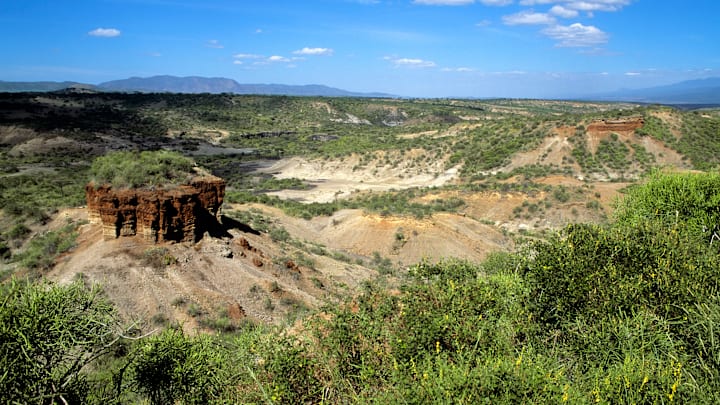
Olduvai Gorge: Cradle of Mankind
Exploring the world-famous archaeological site to study human origins, early fossils, and geological processes
Olduvai Gorge in Tanzania's Ngorongoro Conservation Area represents one of the most important archaeological sites in the world, offering an unparalleled window into human evolution. This dramatic 48-kilometer long canyon has revealed a nearly continuous record of human ancestry spanning nearly two million years, earning its nickname as the "Cradle of Mankind." The gorge's exposed geological layers provide a chronological timeline of human development, tool technology, and environmental changes that shaped our early ancestors.
The Geological Foundation: Reading Earth's History
Olduvai Gorge's significance stems from its extraordinary geological formation, which has created perfect conditions for preserving and revealing ancient fossils. The gorge cuts through sedimentary layers that accumulated in an ancient lake basin over millions of years.
🏞️ Stratigraphic Layers
The gorge exposes seven major geological beds dating from 2.1 million to 15,000 years ago. Each layer represents a different time period with distinct environmental conditions and fossil assemblages, creating a chronological record of evolution.
🌋 Volcanic Ash Dating
Numerous volcanic ash layers between sedimentary deposits provide precise dating markers through potassium-argon dating methods, allowing scientists to establish accurate timelines for fossil discoveries.
💧 Ancient Lake Basin
The site was once a large lake that periodically expanded and contracted, preserving fossils in lake margins and river deposits. These changing water levels created diverse habitats that attracted various hominin species.
Formation of the Gorge
Olduvai Gorge formed through a combination of tectonic activity and water erosion. Approximately 30,000 years ago, seismic activity created a fault line, and subsequent seasonal rainfall gradually carved through the soft sedimentary layers, exposing the ancient fossil beds. This natural excavation process created what amounts to a 90-meter deep cross-section through two million years of Earth's history.
Pioneering Discoveries: The Leakey Legacy
The systematic exploration of Olduvai Gorge began with Louis and Mary Leakey in the 1930s, whose decades of work revolutionized our understanding of human origins.
Key Fossil Discoveries
Zinjanthropus boisei (1959)
Mary Leakey's discovery of the "Nutcracker Man" skull demonstrated that multiple hominin species coexisted in East Africa and pushed back the timeline of human evolution in the region.
Homo habilis (1960s)
The Leakeys discovered the first specimens of this early human species, named "handy man" for its association with stone tools, representing a crucial link in human evolution.
Homo erectus (1970s)
Fossils of this more advanced human ancestor showed the progression toward modern human body proportions and increased brain size.
Laetoli Footprints (1978)
While not in Olduvai proper, Mary Leakey's discovery of 3.6-million-year-old hominin footprints at nearby Laetoli provided direct evidence of bipedal walking in our ancestors.
The OH 5 Discovery: July 17, 1959
Mary Leakey's discovery of the Zinjanthropus boisei skull (cataloged as OH 5) marked a turning point in paleoanthropology. Found in Bed I dating to 1.75 million years ago, the nearly complete skull featured massive teeth and a prominent sagittal crest. This discovery attracted substantial research funding and established Olduvai Gorge as a world-class research site. The fossil was initially thought to represent a human ancestor but was later recognized as Paranthropus boisei, a robust australopithecine that lived alongside early Homo species.
Human Evolution Timeline at Olduvai
The gorge provides evidence of multiple hominin species that inhabited the area across different time periods, illustrating the complex branching pattern of human evolution.
Hominin Species Sequence
| Time Period | Species | Key Characteristics | Significance |
|---|---|---|---|
| 2.1-1.8 mya | Homo habilis | Small stature, brain ~610 cm³, tool-making | First maker of Oldowan stone tools |
| 1.8-1.2 mya | Homo erectus | Larger body, brain ~900 cm³, advanced tools | First human ancestor to migrate out of Africa |
| 1.8-1.2 mya | Paranthropus boisei | Robust features, large teeth, sagittal crest | Specialized vegetarian cousin of humans |
| 1.7-1.2 mya | Homo ergaster | Modern body proportions, advanced tool use | African variant of Homo erectus |
Homo habilis: The Toolmaker
Discoveries of Homo habilis fossils in direct association with Oldowan stone tools provided the first clear evidence of tool manufacture by early humans. The species' name means "handy man," reflecting this association. With a brain size approximately half that of modern humans but significantly larger than earlier australopithecines, Homo habilis represents a crucial transitional form in human evolution.
Coexistence and Competition
Olduvai evidence demonstrates that multiple hominin species coexisted in East Africa for hundreds of thousands of years. The presence of both Homo habilis and Paranthropus boisei in the same layers suggests these species occupied different ecological niches, possibly reducing direct competition. This pattern challenges earlier linear models of human evolution and supports a branching, bushy pattern of evolution with multiple hominin experiments.
Stone Tool Technology: The Archaeological Record
Olduvai Gorge provides the world's most comprehensive record of early stone tool technology, spanning nearly two million years of technological development.
Tool Traditions at Olduvai
🪨 Oldowan Industry
The simplest stone tools, dating from 2.6 to 1.7 million years ago, consisting of choppers, flakes, and hammerstones. These tools represent the beginning of systematic tool manufacture by Homo habilis.
⚒️ Acheulean Industry
More sophisticated tools appearing around 1.7 million years ago, characterized by bifacial hand-axes and cleavers. This technology represents a significant cognitive advance associated with Homo erectus.
🔪 Developed Oldowan
Transitional tools showing features of both Oldowan and Acheulean traditions, indicating technological experimentation and cultural transmission between hominin groups.
Archaeological Excavation Methods
Excavations at Olduvai employ meticulous techniques including:
- Grid System: Dividing sites into precise squares for accurate spatial recording of finds
- Wet Sieving: Processing excavated sediment through water and screens to recover small finds
- Total Station Mapping: Precise three-dimensional recording of artifact locations
- Microstratigraphy: Examining thin layers under microscopes to understand site formation processes
The FLK Zinj Site
The FLK Zinj archaeological site (where the Zinjanthropus skull was found) represents one of the best-preserved early human living sites. Excavations revealed stone tools, animal bones with cut marks, and evidence of centralized activity areas. The concentration of materials suggests this was a home base where hominins processed food, made tools, and possibly shared resources—early evidence of complex social behavior.
Paleoenvironmental Reconstruction
Scientists use multiple lines of evidence from Olduvai to reconstruct ancient environments and understand how climate changes influenced human evolution.
Environmental Evidence
🌾 Fossil Pollen
Analysis of ancient pollen grains preserved in sediments reveals changes in vegetation from forests to grasslands, tracking the drying trend in East Africa that may have driven human adaptation.
🦒 Animal Fossils
Studies of fossilized animals—from giant elephants to small rodents—provide insights into habitat types, climate conditions, and the ecological context of early humans.
🧪 Isotope Analysis
Chemical analysis of fossil teeth and soils reveals dietary patterns, migration behaviors, and environmental conditions through carbon and oxygen isotope ratios.
Climate Change and Human Evolution
Olduvai's record coincides with a period of significant climate fluctuation in East Africa. The transition from forested environments to more open savanna grasslands between 2.5 and 1.5 million years ago may have been a key driver in human evolution. These environmental changes favored adaptations like bipedal walking for efficient long-distance travel, increased meat consumption, and development of more sophisticated tools for processing new food resources.
Modern Research and Conservation
Olduvai Gorge continues to be an active research site where new technologies are revealing fresh insights into human origins.
Contemporary Research Approaches
| Research Method | Application | Recent Discoveries |
|---|---|---|
| CT Scanning | Non-destructive internal analysis of fossils | Brain endocast details, dental development patterns |
| Geochemical Analysis | Reconstructing ancient diets and environments | Evidence of varied hominin diets and habitat preferences |
| 3D Modeling | Digital preservation and analysis of finds | Virtual reconstructions of fragmented fossils |
| Genetic Studies | Analyzing ancient proteins and possible DNA | Evolutionary relationships between hominin species |
Educational and Cultural Significance
Today, Olduvai Gorge features a modern museum and research center that educates visitors about human origins. The site holds deep cultural significance for both the international scientific community and local Maasai communities. Ongoing collaboration between researchers and local people ensures that excavations respect cultural heritage while advancing scientific knowledge. The gorge's status as a UNESCO World Heritage tentative site recognizes its outstanding universal value to humanity.
Conclusion: Olduvai's Enduring Legacy
Olduvai Gorge stands as one of the most significant sites for understanding human origins, providing an unparalleled record of our evolutionary journey. Its exposed geological layers have yielded fossils and artifacts that have fundamentally shaped our understanding of where we come from and how we became human.
Key contributions of Olduvai Gorge to science include:
- Demonstrating the African origins of humanity through concrete fossil evidence
- Revealing the complex branching pattern of human evolution with multiple coexisting species
- Providing the world's most continuous record of early stone tool technology
- Illustrating how climate change and environmental shifts drove human adaptation
- Establishing methodologies that became standard in paleoanthropology worldwide
As research continues with increasingly sophisticated technologies, Olduvai Gorge will undoubtedly yield further insights into the deep history of our species. The site remains not just a monument to past discoveries but a living laboratory where each excavation season brings the potential to rewrite chapters of the human story.

No comments
Post a Comment